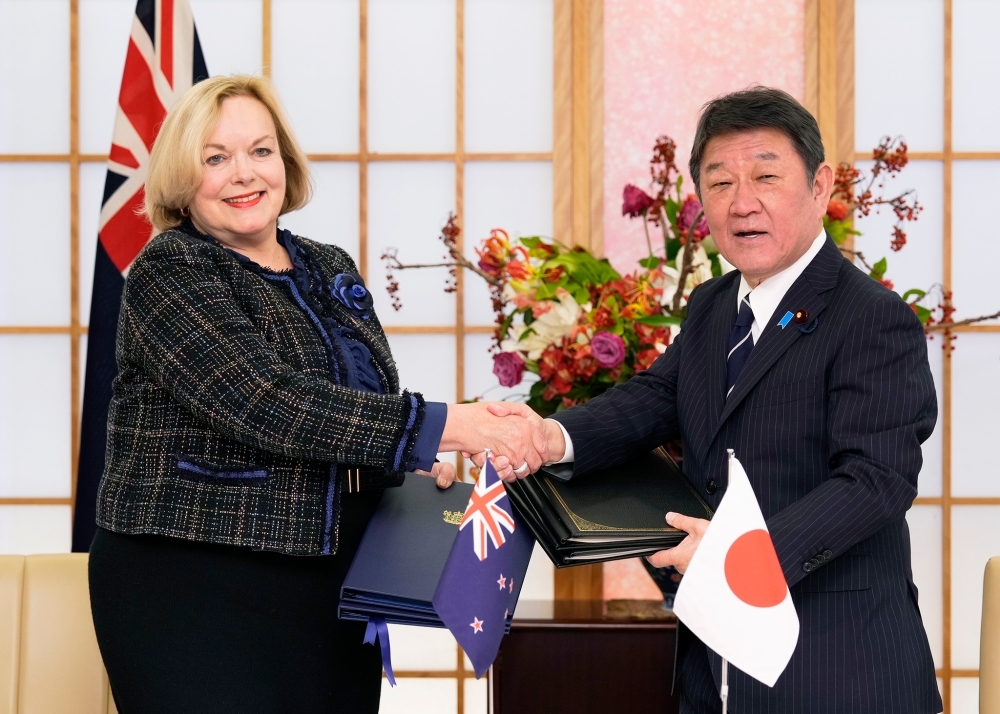
On December 19, 2025, from 11:40 AM in Tokyo, Minister for Foreign Affairs Toshimitsu Motegi and the visiting New Zealand Minister of Defence, Hon. Judith Collins, signed the "Agreement between the Government of Japan and the Government of New Zealand concerning the Reciprocal Provision of Supplies and Services between the Self-Defense Forces of Japan and the New Zealand Defence Force" (Japan-New Zealand ACSA) and the "Agreement between the Government of Japan and the Government of New Zealand on the Protection of Information" (Japan-New Zealand Information Protection Agreement).
Conclusion of ACSA and Expansion of JSDF Activities
The Japan-New Zealand ACSA aims to promote close cooperation between the Japan Self-Defense Forces (JSDF) and the New Zealand Defence Force (NZDF) by establishing a framework for the reciprocal provision of supplies and services in the field of logistical support. The conclusion of this agreement will enable both forces to fulfill their respective roles more efficiently in their activities, and it is expected to further contribute actively to international peace and security.
The activities covered by this agreement include bilateral training, United Nations Peacekeeping Operations (PKO), international humanitarian relief operations, response to large-scale disasters, and protection measures for the evacuation of nationals in emergencies abroad. The categories of supplies and services to be provided are diverse, including food, water, fuel, transportation, communication services, medical services, repair and maintenance services, airport and seaport services, and ammunition. However, it is explicitly stated that the provision of weapons is excluded from this agreement.
Regarding the settlement of provided supplies, the agreement stipulates that, in principle, they should be returned in kind (same type and equivalent), but if that is difficult, reimbursement in currency will be made. The agreement will remain in force for ten years and will be automatically renewed unless specific notice is given. This is believed to facilitate the JSDF's activities in the Oceania region, and it also likely carries a significant intent to check China's increasing military presence in the periphery of the Taiwan Strait.
Changing Security Environment in the Pacific
The extended navigation of Chinese naval vessels in the waters surrounding Australia is fresh in memory. Chinese naval activities in Australia's surrounding waters constitute a security threat to New Zealand as well, making security cooperation with Japan an urgent task for New Zealand.
Strengthening Information Sharing and the "Free and Open Indo-Pacific"
Meanwhile, the simultaneously signed Japan-New Zealand Information Protection Agreement establishes measures for the recipient country to appropriately protect classified national security information exchanged between the two governments. This is expected to further promote information exchange between the two nations.
Although Japan is not a core member of the so-called "Five Eyes," it shares closely aligned security interests with many of its members. In particular, New Zealand conducts intelligence gathering in the Pacific region as a Five Eyes member. With China actively approaching Pacific island nations, cooperation with New Zealand on intelligence is urgent for Japan, making this agreement strategically significant.
In the meeting held after the signing ceremony, the two ministers exchanged views on security cooperation, economic security, regional affairs, and the importance of US engagement in the region. During the discussion, they reaffirmed the importance of further strengthening security and defense cooperation as partners in upholding a "Free and Open Indo-Pacific."